
Ed Tech Blog
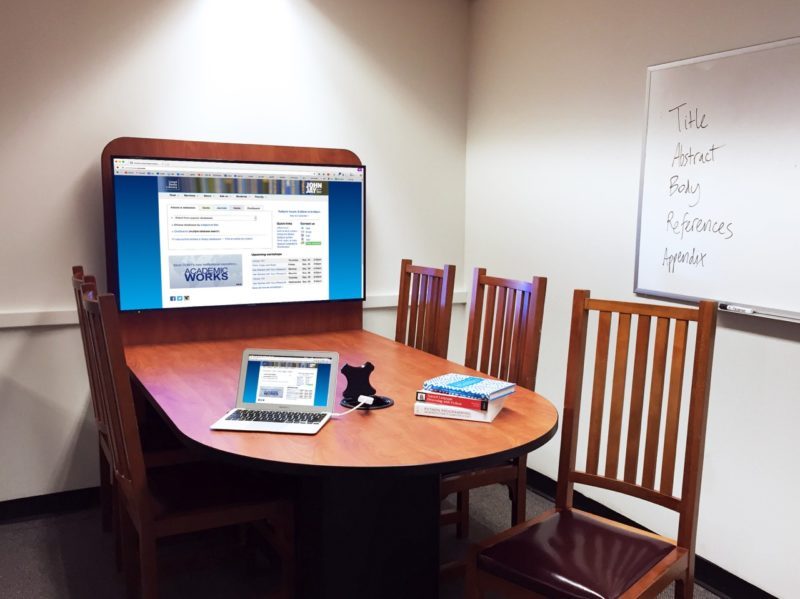
New York, NY (September 7, 2017) – The verdict is in — the John Jay College of Criminal Justice has selected five FSR HuddleVU Collaboration Systems, for its small-group study rooms located in the Lloyd Sealy Library of
Haaren Hall. The systems allow multiple users to share and view their laptops, tablets, and smart phone screens on a main display, underscoring the school’s efforts to encourage student collaboration, group study and shared projects. FSR, a leading manufacturer of a wide variety of infrastructure solution products for the audio/video, Information and Communications Technologies (ICT), education, hospitality, and government markets, released project details from Company headquarters in Woodland Park, NJ.
Lloyd Sealy Library, which holds more than 500,000 books, periodicals, films, microfilms, and digital collections, offered students all the resources necessary for group study and shared projects, except the technology that would result in greater collaboration and increased use of the study-group rooms. Following an exploration and evaluation process of affordable options that would create the ideal environment for people to view and share ideas, the school made the decision to install FSR HuddleVU Collaboration systems.
According to Geng H. Lin, Library Systems Manager, “Everything was built-in so we didn’t have to reconfigure the current space, which was a concern. We decided to try two immediately.” FSR's HuddleVU systems include all the necessary video switching equipment, control hardware, display power control and color-coded captive HDMI cables for a simple, yet effective way to install quickly and operate.
Once the FSR HuddleVU systems were installed in two rooms in the upper library, the College focused on stimulating interest via signage in the library, promotion on the library website and a notification to students via internal electronic communications. The rooms were quickly in such high demand that the College added HuddleVUs in the...

Two different annual conferences, in two different parts of the country took place this month. EdSpaces and LearningScapes. While the individual course content of these conferences can be somewhat dissimilar, they both have a very similar focus: the learning environment as an ecosystem. This broad subject matter includes a variety of topics from space planning and furniture to educational technologies.
I attended LearningScapes this year and was impressed with the expert sessions. I was particularly interested in a small break-out that highlighted junior high school students from across the country as they presented their own perception of the “Schools of the Future.” Each of the three diverse teams had one common theme, the need to bring nature into the learning environment for hands on and “real-life” experiences that offer the opportunity to engage in learning practically rather than theoretically. Bringing the classroom outside or the natural environment inside offers unique challenges. How, then, as technologists, do we complement and supplement natural and hands on learning? This will be an evolving discussion [likely necessitating the inclusion a variety of manufacturers from different markets who will help to create innovative solutions.] VR/AR and adequate power may be a start. I will table...
Read more: How Well Do You Work With Your Institution’s Interiors Team?

This is a guest post provided by Patrick Murray from Controlhaus. You can find out more about Patrick and Controlhaus, here.
HDMI, VGA, Buit-In PC’s and Document Cameras. Sometimes Bluray, DVD and even VHS(!). How many ways to present content does an AV presentation system really need? If we could steal a play from the IT managers handbook and tell users, “That is not supported”, what would our systems look like? What is really the minimum requirement for the typical presenter to get their stuff onto the projection screen?
It is no secret that complicated system are more difficult to set up and maintain. Just keeping enough cables on hand for different signal types can be a challenge, never mind dealing with EDID tables and laptop settings. What would the least complicated AV presentation system look like?
The first thing to go are laptop connections. We no longer support bringing your own laptop. Presenters will need to put their content on the network and use the local PC to display it. But why stop there?
If built-in PC’s are mostly used to stream content, let’s replace them with a network stream player. And while we are at it, let’s...
Many of you who know me well may be surprised by this:
While I love being around and am fueled by the excitement and passion or others, after a day or two of this, I need my alone time to refuel. I am energized as much by my interactions with others as by my quiet time by myself, in my own head. And I NEED both. That balance is as necessary to my professional productivity as it is to my personal passions.
During three days of campus tours and meetings with various media services/ academic technologies/ instructional technologists I was contemplating my own exhaustion. It was a different type of run-down than the understandable flat out tired that comes from a week long trade show in Vegas. It was an overwhelmed type of feeling that made me want to shut down for a few hours and just be quiet. I didn’t want to shut off my brain- I wanted to contemplate my experiences and thoughts about the day in a quiet and secluded setting.
Then I started generalizing my own emotions as those of “most” other people, as we humans are so often prone to do. Our industry, our...
Read more: Open Spaces and Active Learning Aren’t For Everyone
Just a few days ago, Apple announced the specs for its new iPhone 8 and anniversary edition iPhone X devices. Apple’s product announcements are typically highly anticipated, with many speculating about new features and technological advancements months before the formal release. This year’s event, however, seemed to have a grander, more excited energy swirling about it. The iPhone X (the ten year iPhone anniversary edition) was purported to have technology embedded that even Maxwell Smart couldn’t fathom. [Yup, I just totally impressed my Baby Boomer colleagues with that one]
Well, the official announcement, as mentioned, happened a few days ago. But the energy surrounding it hasn’t subsided. All you have to do is find any publication, website, supposed apple addict on twitter and you’ll find someone talking about it- Face ID. This facial recognition software allows a used to unlock his/her phone by simply looking at it. The 3D image processing is smart, meaning “the Bionic chip controls a Neural engine which handles up to 600 billion operations per second so it can “learn” when a user is wearing sunglasses, a hat or even grows a beard.”
I admit, even for a non-apple junkie- this is exciting, interesting and...

From Inside Higher Ed. News, May 13, 2017The past few years have proven challenging for many colleges and universities across the country. Historically, college enrollment is inversely related to the economy; as our economy (job market) improves, some colleges and universities may be seeing as much as 2-3% decline or more in enrollment. Post-secondary education is a competitive market. Where non-profit schools once spent 2% of their tuition revenue on recruiting, today many are spending 5-10 times that- a trend that began gaining steam before declining enrollment.
Schools have also been investing more in student retention. Amenities like apartment style dorms, mixed use buildings, prolific and accessible technology, community building events, gaming centers and high-end athletic facilities are used to lure students on to campus and keep them coming back. It was easy to justify these expenses when enrollment was climbing during the recession. Now, some of these projects may be held or cut as enrollment continues its trending decline.
There are, however, some areas of post-secondary education which are still growing and for which colleges and universities are spending money. Health Sciences, medicine, and STEM (science, technology, engineering and mathematics) disciplines are seeing an increase in interest and...
Read more: College Enrollment is Declining … But There Is Opportunity