
Ed Tech Blog

In this two-part post we’ll take a look at the educational applications of Facebook.
Introduction and Rationale for Facebook Use
The use of Facebook as an educational tool appears to be a polarizing topic among many of those within the field of education. A large majority of educators, particularly those serving in basic education (i.e. K-12) capacities, straight-out fear Facebook use, having been scared (and scarred) by the many stories of disciplinary actions taken against educators who used Facebook unprofessionally (whether by accident or knowingly) (Carter, 2008). Others avoid Facebook use out of disinterest, being of the mindset that education likely has little to gain by integrating a media that was designed to be social by nature (Charnigo & Barnett-Ellis, 2007). The targets of this article, however, are educators that acknowledge the works of educational Facebook use researchers. This body of researchers recognizes an opportunity to enhance traditional learning using Facebook (Chou, 2012; Junco, 2012; Ömer 2012; Ranieri et al. 2012; Yunus et al., 2012; Hart & Steinbrecher, 2011; Lampe et al., 2011; Malita 2011; Promnitz-Hayashi, 2011; Teclehaimanot & Hickman, 2011; Davis, 2010; Kabilan & Abidin, 2010; Maranto & Baron 2010; Madge et al., 2009; Muñoz & Towner, 2009; Selwyn, 2009; Carter 2008; Mazer et al. 2007; Stutzman, 2005). What has compelled this group to become knowledgeable about educational Facebook use? To begin with, the majority of the literature has accepted the statistics that 90% of the nation’s students are using a social networking website daily (Junco 2012; Fogel & Nehmad, 2009; Steinfeld et al., 2008) and that 97% of those students are using Facebook (Junco, 2012). Now combine this ever increasing statistic with the versatile interaction tools Facebook continues to add. The result? A group of educators who recognize the sheer logic of bringing educational material to students...
Manufacturer to thank staff, colleagues, and customers for enduring support with year-long ”Forty and Fabulous” festivities
Woodland Park, NJ (April 19, 2021) — Following a difficult 2020 for the industry and the world, FSR, a leading manufacturer of a wide variety of products for the Pro AV and Information and Communications Technologies (ICT) markets, is looking to 2021 with excitement and optimism as the company commemorates its 40th anniversary. FSR will mark this incredible milestone, branded as “Forty and Fabulous,” with celebrations and giveaways throughout the year. FSR was established in 1981, the same year IBM launched the PC, and Ronald Regan was sworn in as President.
Depending on the month, customers can expect to find special edition FSR candy bars, noisemakers, and bubbly beverages in their deliveries which can be consumed immediately or saved for the virtual Happy Hours FSR is planning for each region. The Company will also be giving away popular products to its long-standing and new client base as a “thank you” for their support.
Jan Sandri, President FSR, explains, “2020 has left its mark on everyone and, while we need to adhere to COVID-19 CDC guidelines, we can still find ways to share some...
Read more: FSR Announces Plans to Commemorate 40th Anniversary with Celebrations Throughout 2021

There are “mind-game” exercises you can do that allegedly help with memory. Similarly, there are innumerable articles about vitamins, minerals, supplements and herbs that claim to enhance memory “vitality.” But one thing is certain when it comes to memory- as you age, your brain becomes less flexible and the world around you becomes more distracting. Short-term memory recollection is compromised and focus is more difficult.
According to the National Center for Education Statistics, “In 2015, there were 11.8 million college and university students under age 25 and 8.1 million students 25 years old and over.” Also of note, the fastest growing cohort in US colleges and universities is the non-traditional student, which includes students 25 years and older. Students 25 years and older may face obstacles to learning and educational success in colleges and universities that traditionally cater to the traditional student population. We’ve written, prior, about non-traditional student enrollment being an opportunity for growth for colleges and universities with declining enrollment. But these opportunities come with the challenge of retaining this population of students who may not retain information the same as a traditional student.
How does this affect educational technologists? Individuals of all ages seem to...
Read more: Education Technology For Impact, Engagement, Memory

This is a guest post provided by Nanda Krish from Wisewire. I found the information to be relevant and in line with the value of content we like to provide on our Collaborate! blog. Please note: FSR doesn't endorse (or not endorse) Wisewire, as we have not evaluated their services. But we thank them for sharing this information with our readers! Enjoy:
You have a unique challenge ahead of you. You know valuable learning tools are emerging and your institution needs to keep up with educational trends. But working within a budget, juggling your day-to-day tasks, and trying to have meaningful conversations with people short on time is not easy. How do you convince multiple education professionals to invest in adaptive learning tools and materials (available from numerous online sources, including Wisewire), which may be an unfamiliar approach to student learning?
What Matters?
Gaining support for any initiative in higher education will always be contingent on whether the idea is best for students. It’s important to completely understand the benefits of adaptive learning tools for individual students and be prepared to describe these benefits to key stakeholders. In addition to basic questions, leaders will have their own specific areas of...
Involving and engaging commuter students on campus is a priority for schools. Generally, commuter student retention is lower than students living on-campus or in college owned housing. This could be the result of a number of factors: commuter students not feeling connected to the school brand (house proud); lack of social connectedness; increased distractions/ responsibilities from non-academic sources; lack of amenities on school grounds created for their complex lifestyle, etc.
StateUniversity.com claims, “Because commuter students spend limited time on campus and limited time creating relationships with other students, faculty, and staff, they have fewer opportunities to engage in quality interactions with these individuals. Therefore they are less likely to make a strong commitment to the university or its programs and are more likely to drop out of school than residential students.”
Fortunately, technology offers a conduit to increased connectivity. While technology alone will not be a campus cure-all for commuter retention, it can help support engagement, encourage group interactivity and provide conveniences to keep commuters on campus longer.
- Technology Rich Lounges- lounges located in central locations are good for commuter students who need a place to park in between classes. Dedicated areas with student- accessible TV’s can promote student interaction.
Read more: How Can Technology Help Engage The Commuter Student?

At the Midwest College and University AV Summit, we were able to tour one of the most technology rich 2-year colleges I have seen- Saint Paul College. While the technology in the classrooms was impressive, it was the technology in the technical areas of the college that were truly exciting. In general, 2 year colleges are under-funded and are, therefore, stuck in a cycle where the budget only allows for minimal upgrades over time. Larger technology investments are typically put on hold, indefinitely.
Saint Paul College is different. Consistently ranked in the top 10 technical and community colleges in the US, they have found a way to stand out. We toured high-technology sim labs for their nursing and medical sciences programs with observation rooms and lecture capture equipment tailored to help students and faculty review the information they need, effectively and efficiently. We tried out divisible flex-rooms with installed wireless presentation products for content sharing.
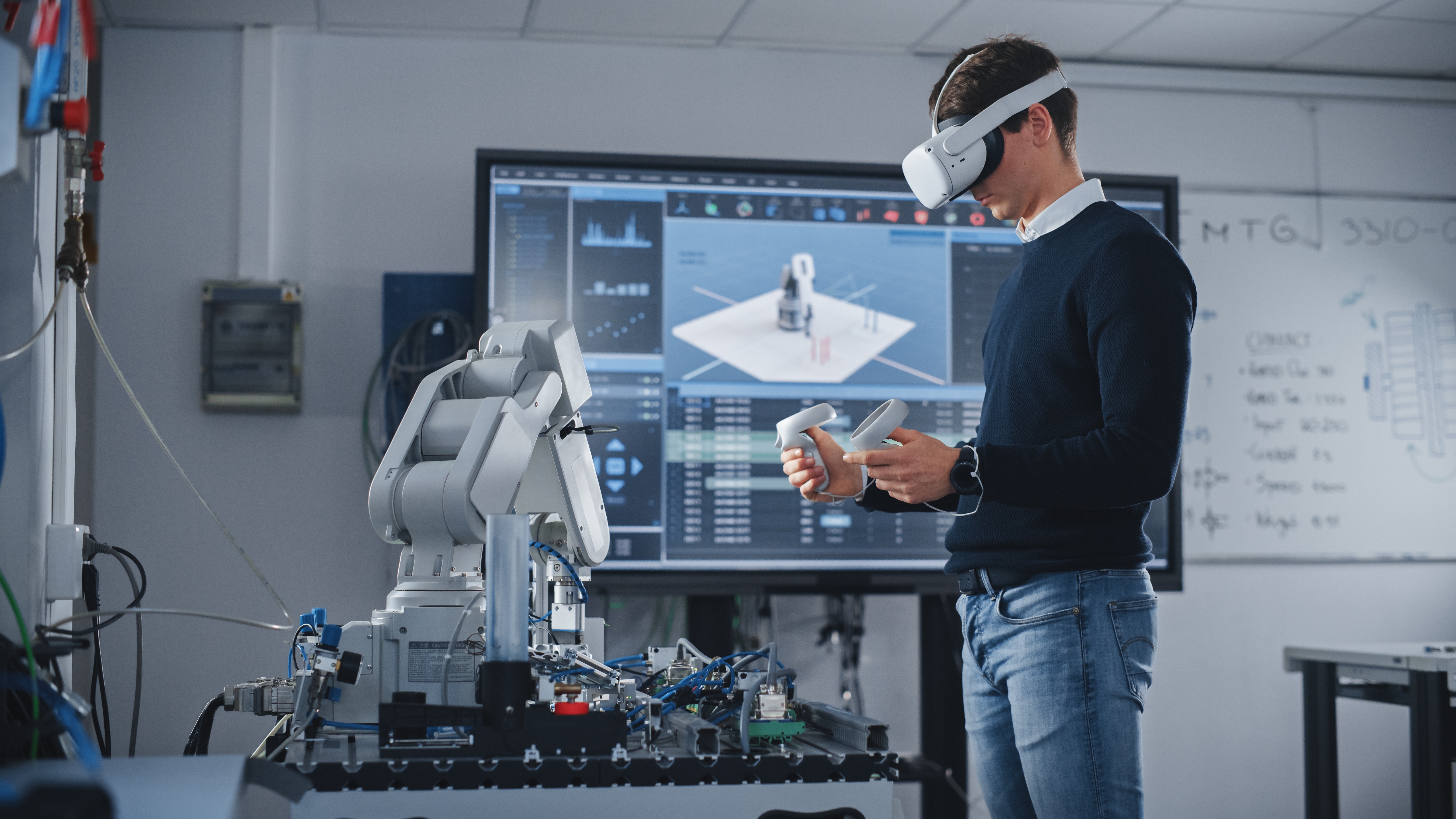
VR Technology for Skilled Trades
But, one of the unique spaces that made an impression on me was the welding shop. Located in the basement, they teach four or five (or more) different welding techniques in this large and well-outfitted area. Available to students...
- Three Signs It May Be Time To Look For Another AV Consultant
- What Students Want: Experiential Learning with Nature INSIDE the Classroom
- John Jay College of Criminal Justice Selects FSR HuddleVU Collaboration Systems for Student Group Study Initiatives
- How Well Do You Work With Your Institution’s Interiors Team?